Wasteland and Blighted Forests
Landscape State · Beauty and Danger in Motion
A source-checked reference to the wastelands and blighted forests of Beast of Reincarnation: how the blight transforms land, how Nushi generate dense forests, what travel context is confirmed and what map rules are not.
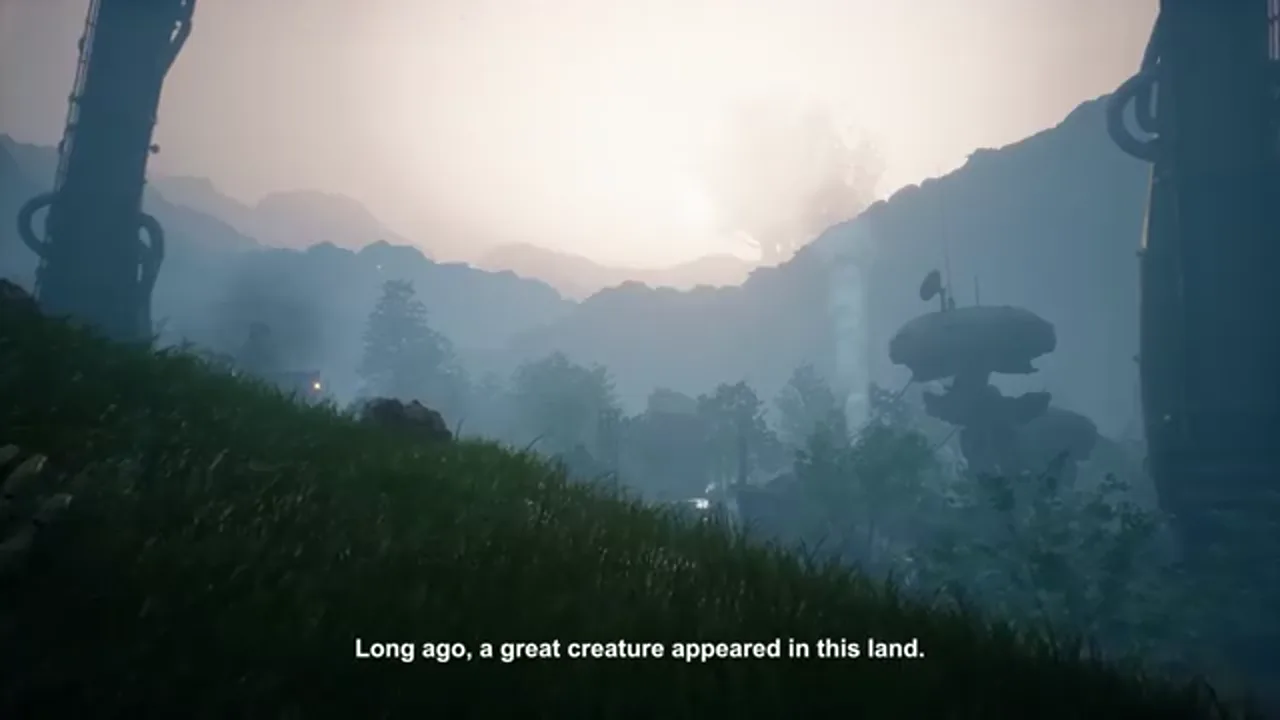
Forests can burst from wasteland as the blight changes the landscape.
Wasteland and forest are not opposite fixed biomes in Beast of Reincarnation. Official descriptions say the blight can gradually transform plains and wastelands into forests. In some places, the change can be abrupt. Game Freak’s Xbox Wire explanation names the dense overgrown result a blighted forest and says giant malefacts called Nushi generate these forests.
That combination gives the setting a clear identity: beauty emerges in a devastated land, but it is connected to danger, malefacts and a world that cannot be treated as static. This page records the confirmed landscape framework without claiming a full dynamic-map model. The public sources do not identify every forest, timer, trigger, route change or permanent state.
Wasteland is a starting condition, not an empty canvas
Fictions describes forests bursting from wasteland in a post-apocalyptic Japan. PlayStation describes a world devastated by blight where few areas remain habitable. The term “wasteland” therefore carries human and environmental weight: it is part of a land affected by a threat that has reshaped both survival and scenery.
It would be inaccurate to say every wasteland is barren, fully uninhabited or permanently unchanged. The official premise specifically tells us that transformation can occur. Nor should a reader assume that every ruined or sandy-looking frame is a gameplay region named “Wasteland.” A visual category and an in-game proper noun are different kinds of evidence.
The useful confirmed takeaway is that devastated expanses and sudden forest growth coexist. The contrast is deliberate worldbuilding, not a simple background swap.
Forest growth can be gradual or abrupt
PlayStation distinguishes two paces. Plains and wastelands can turn into forests gradually, while unseen malefacts can cause abrupt change in some locations. This is more precise than saying the map “randomly changes.” It tells us that transformation is an explicit part of the setting, with at least more than one way it is presented.
The source does not tell us whether gradual change is tied to story progression, a time system, a zone state or another mechanism. It also does not say how often abrupt growth occurs, whether a player can prevent it, or whether every transformation has the same visible result. A route guide needs direct, versioned observation before making those claims.
Forest Transformation and the Changing World separates the confirmed premise from those unpublished system rules. Use it when a question concerns how the change fits exploration or combat context.
Blighted forests have a named cause
The Developer_Direct article adds a crucial detail: the dense, overgrown forests affected by blight are generated by giant malefacts called Nushi. Emma and Koo fight their way through these forests and the malefacts inside them to take the Nushi down. This makes a blighted forest more than a visual theme. It has a named relationship to a major world threat.
Do not overextend the statement. It does not prove that every forest in the game is a blighted forest, that every blighted forest contains the same Nushi, or that a defeated Nushi always restores a region to wasteland. It also does not tell us the exact count of Nushi or a universal encounter order.
The best way to describe an unverified area is as a forested or overgrown landscape visible in the current game. Reserve the formal “blighted forest” label and Nushi connection for places directly named by the game or a first-party source.
Travel through forests is part of the journey
Emma and Koo meet in the east and travel toward the far west on their path to the Beast of Reincarnation. The transformed landscape is part of that movement. The official game page describes the pair crossing a beautiful but harsh world, facing bosses and capturing powers as their bond and abilities develop.
That gives forests a travel function as well as an atmosphere. A player can expect to move through world spaces that are not visually neutral. But a detailed route must still identify the actual in-game area, story state, platform and version. The public overview does not support statements like “the first forest always appears after this boss” or “a forest route permanently locks a settlement.”
For the broader geographic frame, read Japan, Year 4026 and The Far East and the Road Across Japan.
Emma is equipped for altered terrain
PlayStation describes Emma’s plant-like hair as a traversal tool, capable of crossing broken bridges and scaling high walls. This is a separate confirmed ability, but it belongs naturally in a discussion of transformed landscapes. Far-future ruins, elevated spaces and forested terrain can make movement an important part of the journey.
The evidence boundary matters here too. The sources do not say Emma’s hair is required for every forest, that it creates vegetation, or that it can immediately clear a blighted zone. It is a traversal ability with named examples. A current in-game location guide should show exactly where and how it is used rather than replacing a visible route with a generic claim.
Forests are danger and beauty together
The developer’s language presents the world as beautiful and harsh. Dense growth, mist, ruins and hostile creatures can make a landscape visually striking, but the Nushi/malefact context prevents it from being merely pastoral. The blight’s transformation is part of the world’s threat structure.
This does not establish a terrain-stat system. There is no first-party claim that forests automatically improve stealth, alter enemy damage, hide a fixed kind of item or force a particular build. Any such effect needs a reproducible observation. The proper interpretation is thematic and navigational: players should pay attention to surroundings because the world can change, not assume secret modifiers from the color of the grass.
For the combat context, see Nushi: Giant Malefacts and Blighted Forest Bosses and Real-Time Action & Command Combat.
How to document a forest accurately
A detailed forest page should record the in-game region name, the current platform and game version, the story condition, a reproducible entry point and the exact transformation or Nushi claim. If a page says a Nushi generates the area, it should cite the direct dialogue, codex or official label that identifies it.
Screenshots and official video frames are useful illustrations, but they cannot alone prove an area’s name, trigger or state. This site’s source ledger records YouTube video IDs and timestamps for that reason: an image is a contextual visual asset, not a substitute for factual verification.
The verified takeaway
The blight can turn wastelands and plains into forests, sometimes gradually and sometimes abruptly. Giant malefacts called Nushi generate dense blighted forests, which Emma and Koo fight through on their wider journey.
The official material does not provide every trigger, region or map rule. Use the named world concepts to understand the setting, then rely on current in-game evidence for any exact route, item or transformation claim.