Real-Time Action & Command Combat
Core System · Emma and Koo's Shared Loop
How Beast of Reincarnation combines Emma's real-time sword action with Koo's command-based techniques, including parry-earned command points, slowed-time choices and the facts still awaiting verification.
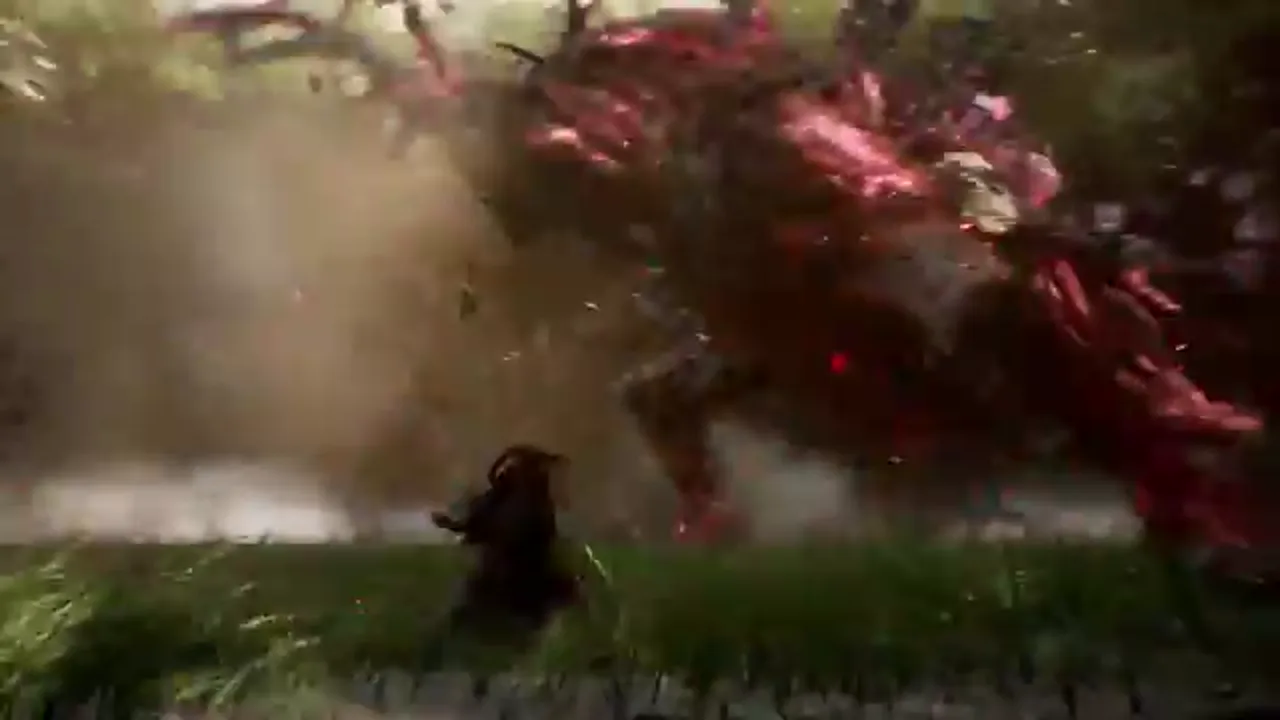
Emma fights in real time while Koo's techniques are selected through commands.
The distinctive idea at the center of Beast of Reincarnation is not simply that Emma has a dog beside her. It is that the game assigns the pair different jobs inside one combat loop. Emma performs sword-based action in real time; Koo uses techniques chosen through a command system. Official descriptions call this a fusion of real-time action and command-based RPG play, and that distinction is more useful than treating Koo as a cosmetic companion or treating the game as a conventional menu-driven turn-based RPG.
This page explains the confirmed structure in spoiler-light terms. It does not invent a full move list, resource cap, best command or boss rotation. Those details need direct verification in the released game and can change with patches. What is established by the official PlayStation and Fictions descriptions is enough to understand the intended rhythm: defend and act as Emma, create access to Koo’s techniques, choose a response under slowed time, then return to the immediate fight.
Emma keeps the action moving
Emma is the character performing the real-time portion of combat. Fictions describes her sword abilities as the action side of the partnership, while PlayStation’s breakdown says she fights with sword-based actions in real time. That means the moment-to-moment space, enemy attacks and defensive decisions do not pause simply because a companion exists.
The most important confirmed defensive action is the parry, described in the PlayStation material as a “just guard.” A successful parry is not presented merely as a way to avoid damage. It earns points that activate Koo’s skills. In other words, a precise defensive read feeds the companion-command system. The link matters because it makes timing part of the strategic layer instead of a separate reflex test that only rewards a counterattack.
That is also why the game’s technical-combat label should not be interpreted as “press attack faster.” The official setup points toward a sequence of observing an enemy, choosing whether to defend or reposition, then taking advantage of the resource or opening created by a correct response. Specific enemy timings and player routes should be treated as guide material only once they are tested, but the relationship between parry and command points is confirmed.
Koo is commandable, not passive
Koo is a malefact dog and Emma’s companion, but in battle his role is active. Official descriptions say players give Koo commands to unleash techniques in a way that resembles a command-based RPG. This does not mean the entire game converts into turns each time a command is selected. Emma’s action remains real time; the command layer is a deliberate interruption that lets the player decide how Koo contributes.
PlayStation’s controls description uses the Triangle button on PS5 as the example for opening Koo’s command menu. Platform button names can differ, so players on Xbox or PC should check their own settings rather than assuming the same label. The underlying feature is the relevant fact: the command menu can be accessed during combat and it slows time while a technique is selected.
Slowing time does two jobs. First, it lets a player make a tactical decision without demanding that every choice be entered at full action speed. Second, it preserves the pressure of the battlefield: enemy position, distance and the consequences of the choice still matter once normal time resumes. This is why “one-person, one-dog action RPG” is a better summary than either “pure action game” or “turn-based RPG.” The two systems coexist instead of replacing one another.
The confirmed resource loop
The official sequence can be stated carefully:
- Emma engages in real-time combat.
- A successful parry/just guard earns points.
- Those points can activate Koo’s skills.
- The player opens the command menu and selects a Koo technique while time is slowed.
- The fight returns to real-time action, with Emma and Koo acting as a coordinated pair.
This is a system outline, not a universal recipe for every encounter. The source does not publish the number of points required for every technique, whether all parries award the same amount, the full command list, or exactly how each enemy reacts. A responsible guide should stop at the confirmed loop until those details have been directly checked.
The practical implication is still useful: Koo’s techniques are connected to player timing. If a player ignores the defensive part of Emma’s toolkit, they may be giving up access to a central companion resource. Conversely, a player who understands when to defend gains more opportunities to make deliberate command choices. That is a much tighter relationship than a typical AI companion who simply attacks on their own.
A decision tool, not a panic button
Because the command menu slows time, it can be tempting to describe it as an emergency pause. The official wording is more precise: it slows time to give the player a chance to select Koo’s techniques. That makes it a decision tool. Use it to assess the immediate situation and choose from the techniques that are currently available, rather than assuming it removes all risk or guarantees a safe recovery.
The correct use will vary as the game reveals more systems. A close-range threat might reward one sort of command, a mobile foe another, and an encounter with several enemies may change the value of spending a resource immediately. Until the techniques and their effects are verified page by page, this wiki will not label a particular command as mandatory or claim a hidden cooldown rule. The useful foundation is to treat the slowed-time menu as part of a larger real-time plan: read, defend, select, execute and reassess.
How v1.0.7 affects the system discussion
Fictions’ first post-launch patch, v1.0.7 / v1.005.000, includes an adjustment to the parry window when Emma is taking damage. It also lists boss balance changes across difficulty levels and normal-enemy encounter changes on Normal. These are live patch notes, so they matter when reading any combat advice written before August 10, 2026.
The patch notes do not publish detailed numerical parry-frame data or a boss-by-boss balance table. It would be inaccurate to turn “adjusted” into a claim that parries are universally easier, harder or identical across every situation. The sound advice is to make sure the latest patch is installed, then test the current timing in a low-risk encounter before relying on footage or a launch-day guide.
For version numbers, update instructions and the separation between implemented changes and future plans, read Patches, v1.0.7 Changes & Known Issues. That page is maintained from Fictions’ support articles rather than rumor or copied patch summaries.
What the official material confirms about teamwork
Fictions frames Emma and Koo as a unit. Its game page describes their combination as an action-RPG experience built around Emma’s sword abilities and Koo’s command techniques. The PlayStation announcement expands that into a clear input-resource relationship: just guards earn points, the points activate Koo’s skills, and the player chooses commands through the slowed-time menu.
That is enough to say the relationship is mechanical as well as narrative. It is not enough to say that Koo always pins enemies, that a particular technique creates a guaranteed opening, or that one command path dominates all others. Those are the kinds of claims that need a dated, reproducible observation from the shipped game. Maintaining that boundary is especially important for a site that began with pre-release coverage.
What remains to verify
Several useful questions are still outside the primary-source detail available to this page: the full list of Koo techniques, their costs and unlock conditions, whether point gain differs by difficulty or attack type, the final controller mappings on every platform, and how individual boss behaviors interact with commands. Each is a good candidate for a dedicated reference page once it can cite footage, a current in-game observation or an official explanation.
For now, use the wider Combat System page for the high-level action framework and Commanding Koo for the companion focus. Players starting out should also read the Beginner’s Guide, then return here after learning the basic parry and command sequence. The key lesson is simple: Emma’s timing creates options, and Koo’s command menu turns those options into deliberate tactical choices.