Combat System: Real-Time Action Meets Commands
Combat Overview · Emma’s Action and Koo’s Tactics
A source-checked overview of Beast of Reincarnation combat: Emma’s real-time katana action, parry-earned points, Koo’s slowed-time command selection, difficulty modes, equipment context and the technical details not yet published.
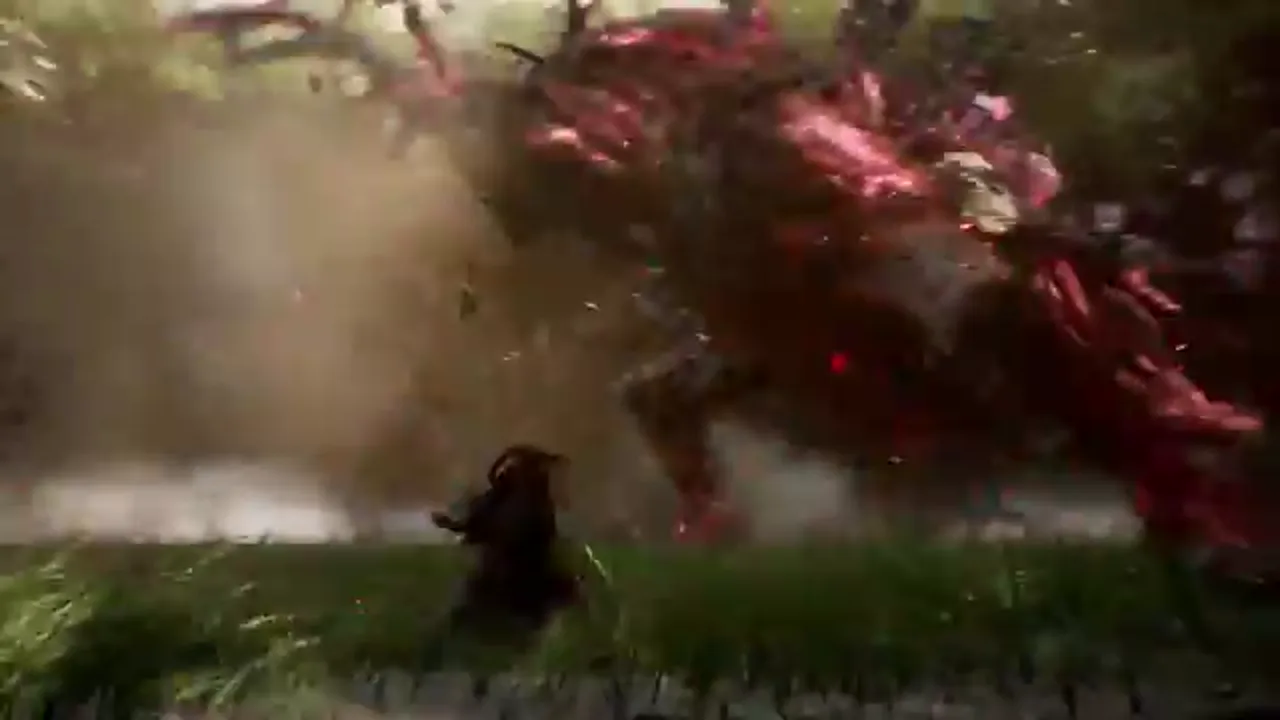
Emma fights in real time; Koo’s skills are selected through commands.
The combat system of Beast of Reincarnation is a deliberate fusion of Emma’s real-time action and Koo’s command techniques. The official description calls it a one-person, one-dog action RPG: Emma handles katana action in real time, while the player selects Koo’s techniques through a command menu. A successful parry or just guard with Emma earns points that activate Koo’s skills, and time slows while the player chooses a command.
This overview describes the confirmed system architecture. It does not publish a fictional combo list, universal damage formula, stamina rule, attack cancellation table, complete command catalogue or enemy timing chart. Those details belong to current in-game testing. The official framework is already enough to explain what makes the game distinct: action timing creates tactical options for a two-character team.
Emma owns the immediate action layer
Official PlayStation and Fictions material describe Emma’s sword-based or katana action as real time. That means the player reads threats, moves through the battlefield and responds through active control rather than issuing every choice from a fully turn-based menu.
The sources do not say that real-time action is a particular subgenre template. They do not provide a full move list, state every cancel option or identify a universal stamina mechanic. Do not use an unrelated action game as a substitute for the game’s own rules. The reliable statement is that Emma performs the live action portion of the partnership.
Emma’s traversal and blightborn plant ability belong to the wider character design, but their exact combat interactions need direct evidence. For her character framework, see Emma: The Blightborn Sealer.
A successful parry earns a resource
PlayStation calls the key defensive action a parry or just guard. A successful parry earns points, and those points activate Koo’s skills. This makes defensive timing part of the resource loop, not merely a way to avoid an attack.
The official sources do not state that every attack is parryable, that every success awards the same number of points or that points have a published cap. They do not provide frame data. A proper detailed guide should record the current version, difficulty, attack and result before claiming an exact timing rule.
The practical lesson is still clear: a player who develops a reliable defensive read gains access to an important tactical layer. Parrying, Positioning and Difficulty explains the confirmed defense context and the limits of current detail.
Koo adds the command layer
Koo is a malefact dog and a player-commanded combat partner. His techniques are selected through a command menu. Xbox Wire says the menu slows combat and gives a player breathing room to assess the battlefield and strategize. This is a decision space inside live action, not a replacement for it.
The current first-party overview does not list every technique, its range, cost, target behavior or cooldown. Do not label a command as a guaranteed heal, stun, finisher or pin based on a brief video. Use the live in-game description and a repeatable test for any detailed skill page.
The design relationship is the important fact: Emma’s timing produces points, and Koo’s commands turn those points into deliberate team action. Commanding Koo gives the dedicated companion explanation.
Slowed time supports thought under pressure
The menu slowdown is central to the game’s intended tempo. Game Freak says it wanted moments where players could think with the tactical mindset of a command-based RPG rather than relying entirely on split-second reflexes. This is a valuable distinction for new players.
Slowed time does not mean an unconditional pause. The fight resumes after a selection. Use the window to read the visible situation: Emma’s position, nearby threat, available command options and likely next action. The official material does not promise that every command can be chosen in every state, so the on-screen current menu is the source of truth.
On PS5, PlayStation uses Triangle as the example input for the menu. Players on other platforms should consult live controls rather than assuming identical labels. Controls, Remapping and Presentation Settings covers the current support scope.
Difficulty changes the learning context
Game Freak confirms Normal, Hard and Story modes. Normal is standard, Hard is highly challenging, and Story Mode provides more forgiving parry timing and reduced enemy damage. Since parries feed the command resource, this is a meaningful way to choose how quickly the central loop becomes comfortable.
The sources do not publish a complete numerical table. Story Mode should not be described as deleting combat, and Hard should not be assumed to change every system. Choose based on the experience you want, then name the mode whenever you share an observation. Difficulty Modes records the precise official claims.
Builds support behavior
The combat system includes customization. Spirit Stones grant effects based on actions during battle. Exploration can yield new katanas for Emma and Charms for Koo with specialized bonuses. The official game page also identifies ranged, stealthy and aggressive playstyle directions.
These facts support experimentation, not a single mandatory setup. The sources do not give a final tier list or every interaction between a skill, stone, katana and Charm. Start with a clear goal, read current in-game text and change one component at a time. A build that supports actions you can reliably perform is more useful than an unversioned recommendation.
Builds & Spirit Stones and Gear and Equipment provide the evidence-led process.
Major encounters use the same core loop
Nushi are giant malefacts that generate blighted forests. Emma and Koo fight through those areas to defeat Nushi and gain power and skills on the path toward the Beast of Reincarnation. Major fights sit inside the same action-and-command design; they do not justify a separate invented boss ruleset.
The official sources do not publish every boss phase or weakness. Record platform, version and difficulty when assessing a detailed encounter. Fictions’ first post-launch patch includes boss-balance changes across difficulties, so launch-era strategy statements may need retesting.
The verified takeaway
Emma’s real-time katana action, parry-earned points and Koo’s slowed-time command selection form one combat system. Difficulty and equipment choices shape how a player learns and expresses that loop, while Nushi encounters give major fights a progression role.
The detailed technical tables remain outside the published primary overview. Use current in-game evidence for exact claims, and use this page for the confirmed architecture of the system.