Community Verdict: Blade Art Kiku Dominates as Players Debate Beast of Reincarnation's Enemy Variety
Early players have completed Game Freak's ambitious action RPG. We examine the Sekiro-esque parry system, the lack of enemy variety, and the broken combat meta.
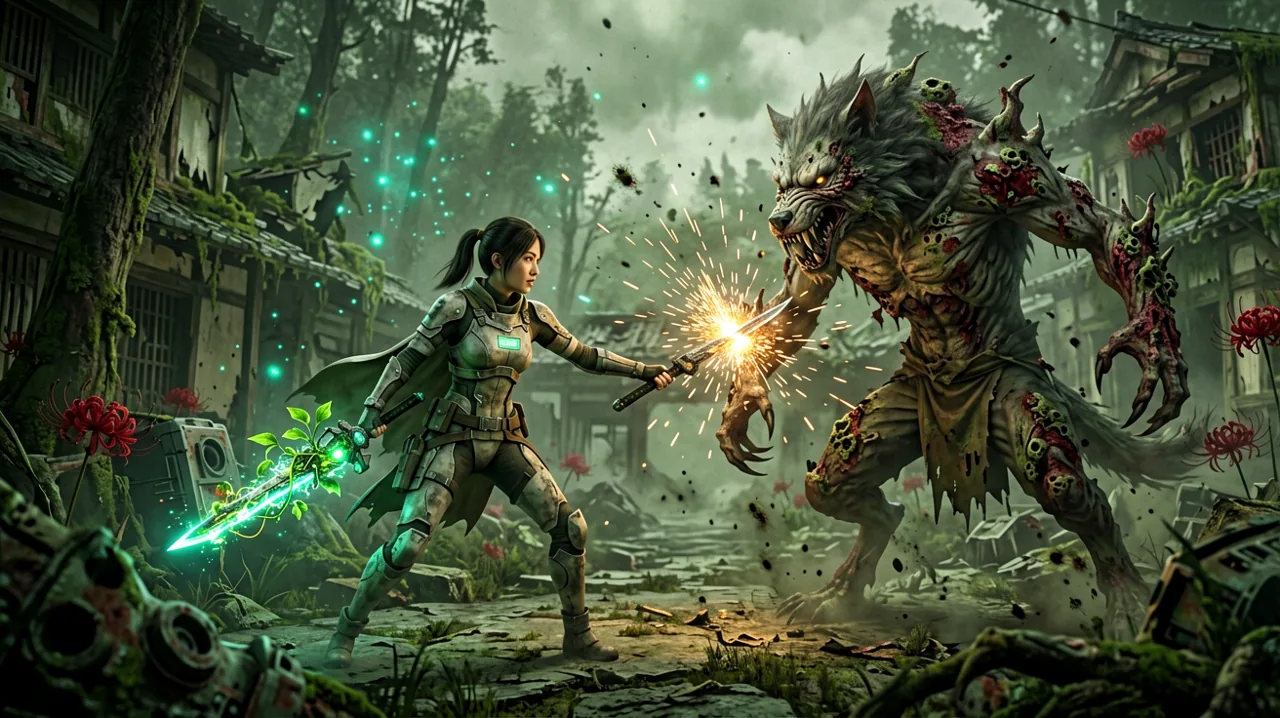
It has been nearly two weeks since Beast of Reincarnation launched globally, and the community is finally reaching the credits of Game Freak’s highly anticipated, non-Pokémon AAA endeavor. Set against the bleak, overgrown backdrop of a 4026 Japan consumed by the parasitic “blight,” the journey of the 18-year-old Sealer Emma and her canine malefact companion Koo has proven to be a surprisingly complex experience. While initial impressions were somewhat mixed due to technical hiccups, players who have fully digested the roughly 24-hour campaign are forming a strong consensus.
What has emerged from the community is a portrait of a game with incredibly high peaks and noticeable structural valleys. The combat mechanics, specifically the deflection system, are being universally praised, drawing heavy comparisons to some of the most revered action titles of the last decade. Yet, as players optimize their approaches, they are uncovering balance issues and design limitations that expose Game Freak’s growing pains in the action RPG genre. From the overpowered nature of certain skills to the disappointingly limited pool of enemy types, here is a detailed look at the current meta and the community’s verdict on Beast of Reincarnation.
The Deflection Mechanics Are the Star of the Show
Before addressing the criticisms, it is important to acknowledge what Game Freak absolutely nailed: the core combat rhythm. Many players have noted that if you are wondering is Beast of Reincarnation a true Souls-like?, the answer leans heavily toward the rhythm-based aggression of Sekiro: Shadows Die Twice rather than the slow, stamina-management of Dark Souls.
Players completing their first playthroughs report that the parry and deflection mechanics are incredibly satisfying. The tactile feedback of crossing blades with heavily mutated monstrosities while managing Emma’s plant-like hair vines creates a distinct flow. When you properly time a deflection against a rapid string of attacks from a corrupted samurai or a charging Nushi beast, the visual sparks and heavy audio cues provide an immense dopamine rush. The combat actively rewards staying in the pocket. Rather than endlessly rolling away, the game wants you to stand your ground, seamlessly weaving your strikes with Koo’s tactical interventions.
This satisfying core loop is largely what carries the experience during the slower narrative segments of the early game. Even when the story takes its time to establish the stakes in the initial chapters, the sheer kinetic joy of the combat keeps the controller firmly in the player’s hands. For a deeper understanding of the early game pacing, you can check our First Hours breakdown.
The Meta Emerges: Why “Blade Art: Kiku” is Breaking the Game
However, as players have reached the endgame, a clear imbalance in the skill tree has emerged. When exploring optimizing your builds and spirit stones, it becomes apparent that not all abilities were created equal. The community has quickly identified a “broken” setup centered around a specific skill: Blade Art: Kiku.
Named after the Japanese chrysanthemum, this skill utilizes Emma’s blight-sealing vines to deliver an overwhelming burst of damage. Across the Beast of Reincarnation subreddits, players are posting videos of themselves completely melting late-game bosses. High-profile, dual-encounter fights like Kunai & Kirin—which are theoretically designed to test the player’s spatial awareness and ability to command Koo to distract one target while Emma focuses on the other—are being bypassed entirely by the sheer raw output of Blade Art: Kiku.
Players are noting that while coordinating with Koo feels fantastic when executed properly, relying on Kiku makes the combat balance feel somewhat disappointing for hardcore action veterans. The skill easily breaks enemy posture and applies massive health damage, effectively stunlocking even the most formidable malefacts. Game Freak has historically struggled with competitive balance in their flagship RPGs, and it seems that legacy has unfortunately translated into their action combat. Unless a future patch specifically targets the damage scaling of this skill, Blade Art: Kiku remains the definitive choice for anyone looking to breeze through the game’s final chapters.
The Irony of Enemy Variety
Perhaps the most persistent and vocal criticism coming from the player base revolves around enemy variety. The irony is not lost on the community: the studio responsible for designing over a thousand unique Pokémon has shipped a 20-to-30-hour action RPG featuring only about 10 to 15 distinct base enemy types.
Once you push past the halfway point of the game, you will begin to notice a severe over-reliance on palette swaps and slightly upscaled variations of earlier foes. You fight the same blight-infected villagers, the same corrupted wildlife, and the same mechanical-organic hybrids repeatedly. The encounters attempt to stay fresh by mixing enemy groupings or placing them in hazardous environmental conditions, but the lack of mechanical diversity becomes glaring.
Trophy hunters and completionists have been particularly vocal about this issue. The combat loop, no matter how satisfying the parrying feels, eventually suffers when you are reading the exact same telegraphs for the 50th time in a row. The repetition extends into the boss encounters as well. While the main story bosses have unique designs, the optional exploration areas heavily reuse these assets. A boss you fought at the end of Chapter 3 might appear as an oversized elite mob roaming the map in Chapter 8.
The Complete Nushi Boss Roster Revealed
Speaking of bosses, dedicated players have officially mapped out the entire roster of major encounters. The bosses, often referred to as Nushi (a term referencing guardian spirits or masters of the land), heavily feature Latin and astronomical naming conventions that contrast beautifully with the far-future Japanese setting.
If you are looking for a complete Boss Fight Primer, here is the list of major encounters you will face in Beast of Reincarnation:
- Rangifer: An early-game encounter that tests your basic deflection timing.
- Lacerta: A highly mobile, lizard-like malefact that forces you to utilize your vine mobility.
- Ursa: A massive, heavy-hitting beast where Koo’s distraction mechanics are vital.
- Corvus: An aerial threat that requires precise anti-air parries.
- Erymanth: A relentless, charging foe with a massive health pool.
- Crimson Malefact: A mid-game difficulty spike that checks your build optimization.
- Taurus: A brutal, arena-restricting fight.
- Shidou and Nue: A complex narrative fight involving human and malefact synergy.
- Kunai and Kirin: The late-game dual boss that is currently falling victim to the Blade Art: Kiku meta.
- Nue Malefact (Extra Boss): A hidden, extremely punishing encounter for completionists.
While the designs of these core bosses are spectacular, the complaint remains that outside of these tentpole moments, the game struggles to offer unique challenges. For those seeking detailed strategies for each of these encounters, our comprehensive Combat Guide offers step-by-step breakdowns for dealing with their specific blight-infused attacks.
A Community Hack for Maximum Atmosphere
Despite the criticisms regarding balance and variety, one area where Beast of Reincarnation excels without caveat is its atmosphere. Game Freak has successfully crafted a bleak, oppressive world. The scattered mountain settlements, the overarching threat of the blight, and the general sense of post-apocalyptic isolation give the game a remarkably distinct tone.
Interestingly, a highly upvoted post on the gaming subreddit has revealed an unconventional way to enhance this experience: turn off the music.
Players are discovering that muting the game’s background score and relying entirely on the environmental audio, combat sound effects, and the original Japanese voiceover elevates the tension immensely. The stock ambient music, while serviceable, can occasionally feel generic. However, exploring a decaying 4026 Tokyo with only the sound of Emma’s footsteps, the ambient rustling of infected foliage, and the guttural growls of Koo creates an incredibly cinematic, survival-horror aesthetic. For players who are heavily invested in the Story and Setting Explained, this audio tweak is highly recommended to fully appreciate the world Game Freak has built.
Final Thoughts: A Solid Foundation
As the dust settles on the launch window, the verdict on Beast of Reincarnation is largely positive, albeit with asterisks. It is not necessarily a flawless Game of the Year contender, but rather a “solid, highly enjoyable game” that proves Game Freak can successfully operate outside of their established comfort zone.
The story, which many agree takes a while to find its footing, genuinely pays off in the final six chapters. The bond between Emma and Koo translates well into both narrative and gameplay mechanics. If Game Freak decides to produce a sequel, they have established a phenomenal combat framework. If they can solve the enemy variety issue and tighten the skill tree balancing, a potential follow-up could easily rival the titans of the action RPG genre. Until then, we will continue parrying our way through the ruins of Japan—and maybe relying just a little bit too much on Blade Art: Kiku.