Beast of Reincarnation Director Reveals Blade Runner Inspirations and New Details on Koo’s Combat Role
Game Freak's upcoming action RPG combines Blade Runner aesthetics with Princess Mononoke animism, featuring generous parry windows and FF7 Remake-style command combat.
Game Freak is preparing to release its most ambitious project to date, and recent developer interviews have finally pulled back the curtain on the core mechanics driving this dark, parasitic universe. Scheduled to launch on August 4, 2026, for PlayStation 5, Xbox Series X|S, and PC, Beast of Reincarnation represents a massive tonal shift for the studio historically known for family-friendly monster catching. Moving entirely away from colorful, cheerful environments, the development team has spent over half a decade constructing a far-future vision of Japan ravaged by a virulent botanical mutation known as the blight. Recent conversations with director Kota Furushima, alongside comprehensive media previews, have crystallized the project’s creative origins and its unique gameplay loop. These discussions confirm that the title is far more than a simple genre clone. The developers are intentionally blending a distinct array of cinematic influences with accessible, command-based action systems that prioritize rhythm and visual flair over punishing, trial-and-error difficulty.
A Vision Five to Six Years in the Making
Creating a brand new intellectual property of this scale requires immense resources, and industry reports confirm that Beast of Reincarnation has been in active development for five to six years. This extended production cycle marks an incredibly significant milestone, detailing Game Freak’s massive transition from Project Bloom into a full-fledged AAA Unreal Engine 5 action RPG. The result is a highly substantial experience; current developer estimates suggest the main campaign will take most players between 30 and 40 hours to complete.
Rather than spreading the narrative thin across a massive, potentially empty open world, the development team has opted for interconnected “open zones.” These sprawling, distinct environmental biomes allow for highly curated encounter designs, intricate environmental puzzles, and tightly paced progression. Players will utilize “bonfires” scattered throughout these zones as safe havens to upgrade their gear, manage their collected spirit stones, and prepare for grueling encounters with massive malefact bosses. This structured approach to level design ensures that the tension remains consistently high as Emma and her companion Koo push deeper into the corrupted mountain settlements, allowing for dense storytelling without the pacing issues that often plague vast sandbox games.
Blade Runner Meets Princess Mononoke in 4026 AD
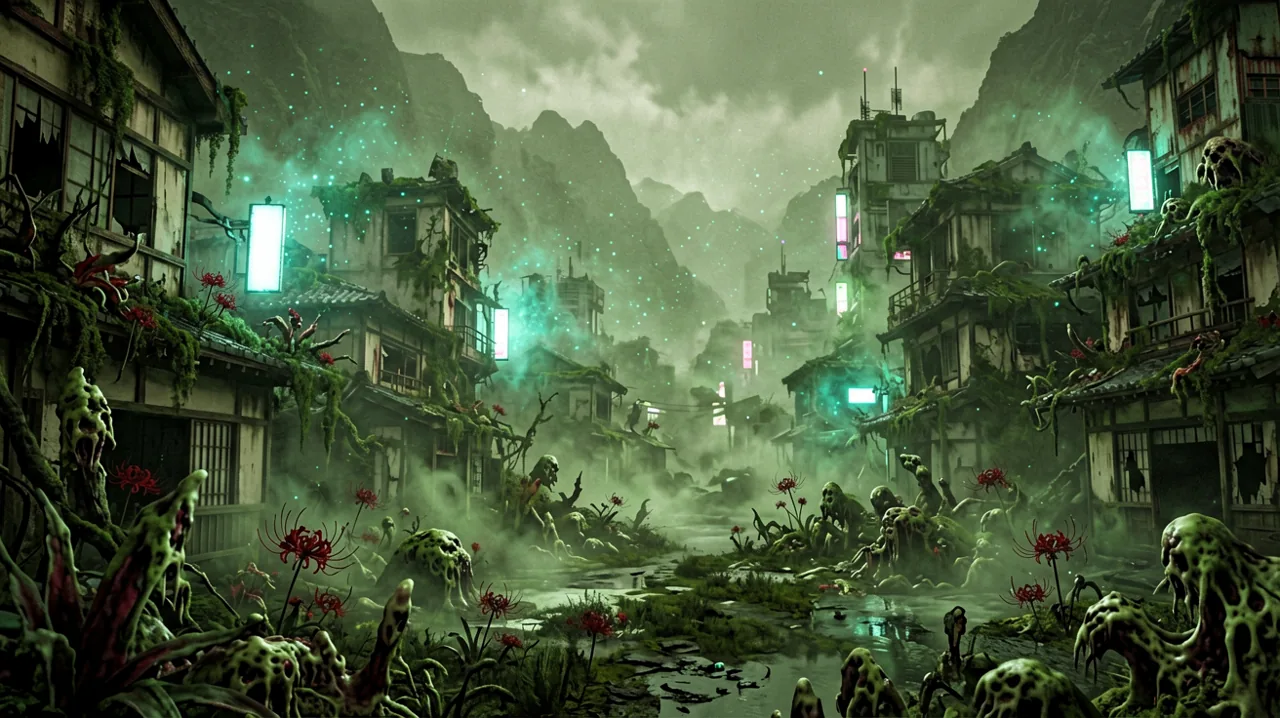
Visually and thematically, the game operates on a fascinating juxtaposition. Director Kota Furushima recently discussed the unexpected cinematic inspirations driving the art direction, explicitly citing Ridley Scott’s Blade Runner and Hayao Miyazaki’s Princess Mononoke, alongside Yoko Taro’s existential masterpiece NieR: Automata. This diverse blend of influences manifests powerfully in the world of 4026 AD. The environments feature decaying, high-tech cyberpunk architecture that has been completely choked out by aggressive, hyper-evolved flora.
The blight is not merely a static poison; it acts as an intelligent, corrupting natural force that actively reclaims human technology, creating neon-lit ruins blanketed in dense green spores. This environmental storytelling directly ties into the foundational lore of the setting, illustrating a world where surviving humans are pushed to the absolute fringes of civilization.
Emma herself embodies this thematic clash perfectly. As an 18-year-old Sealer, she manipulates her own mutated, vine-like hair to navigate these shattered ruins. She relies on these organic appendages to swing across wide chasms, pull herself toward distant precipices, and scale decaying skyscrapers. Her affliction functions simultaneously as a physical manifestation of the world’s trauma and the ultimate biological tool required to traverse the extreme verticality of these open zones. You can learn more about how her physical characteristics reflect her tragic past in our detailed analysis of Emma’s character design and trauma.
Stepping Away from the Souls-Like Label
Since the initial gameplay reveals, the community has relentlessly debated the game’s difficulty curve, frequently comparing the mechanics to FromSoftware titles due to the dark aesthetic and bonfire checkpoint system. However, the development team has explicitly stated that Beast of Reincarnation is definitively not a traditional souls-like experience. While it retains certain structural elements, the core moment-to-moment swordplay is designed to be significantly more accessible.
According to recent translated previews, the combat parry windows are reportedly much more generous than the demanding precision required by Sekiro: Shadows Die Twice. Instead of harshly punishing players for missed deflections, the developers cite Stellar Blade, Ghost of Yōtei, and Final Fantasy XVI as their primary gameplay inspirations. The action is remarkably fast-paced and emphasizes highly responsive, flowing combo strings over methodical defense. Emma dances through the battlefield, relying on momentum and aggressive strikes to build up her ability to absorb and seal the blight surrounding her enemies.
This sealing mechanic is vital, as it allows her to purge the corruption from weakened malefacts and channel that energy into her spirit stones for powerful upgrades. For players concerned about artificial difficulty walls, this confirmation signals a much more welcoming approach to the hardcore action RPG genre. We have previously discussed the mechanical nuances and defensive strategies of these encounters in our overarching combat guide, and further analyze the genre debate in our is it a souls-like discussion.
Koo’s Tactical Slow-Motion and ATB Influences
Perhaps the most mechanically distinct revelation centers around Emma’s canine companion, Koo. In a dedicated interview with GameRant, Furushima elaborated on the dog’s crucial role in the heat of battle. Koo is not a passive AI follower, a cosmetic pet, or an occasional summon; he is an actively managed party member operating on a combat system heavily inspired by the Active Time Battle (ATB) mechanics of Final Fantasy VII Remake.
During intense skirmishes, players can trigger a tactical slow-motion mechanic, briefly pausing the frantic real-time action to issue specific positional commands or devastating combination attacks directly to Koo. This layer of strategy forces players to constantly read the battlefield, balancing Emma’s rapid, fluid sword slashes with Koo’s heavy, interruption-based strikes. Utilizing Koo effectively is absolutely essential for staggering massive malefact bosses, effectively creating the necessary openings for Emma to step in and seal their corrupted energy.
Furthermore, Koo’s identity as a malefact himself adds a layer of narrative resonance to the combat—a beast utilizing his own blight-infected strength to tear down his feral counterparts. The strategic synergy between the young Sealer and her mutated companion is the true beating heart of the game’s combat loop, creating a dynamic rhythm that we explore further in our breakdown of Koo’s tactical slow-motion skills.
Game Pass Arrival and PC Anticipation
As the August 4 release date approaches, anticipation across all platforms is reaching a boiling point. The recent confirmation that Beast of Reincarnation will launch as a Day One title on the Xbox Game Pass service has dramatically expanded its potential audience, ensuring that millions of players will have immediate access to Game Freak’s bold new vision. You can review the full details regarding Microsoft’s subscription rollout in our Game Pass availability breakdown.
Meanwhile, the PC gaming community remains highly active, analyzing unconfirmed, community-reported system requirement leaks to determine the hardware necessary to cleanly render the game’s dense spore effects, towering bosses, and neon lighting on Unreal Engine 5. While official PC specifications have yet to be verified by the publisher, the extended five-to-six-year development timeline suggests a highly optimized, visually demanding experience that will push modern graphics cards.
Whether you are drawn to the intricate command-based combat, the tragic lore surrounding the young Sealer, or the striking juxtaposition of cyberpunk decay and overgrown wilderness, Game Freak’s ambitious departure from its traditional roots is shaping up to be a defining moment for the action RPG genre.