Beast of Reincarnation Community Roundup: Full Soundtrack Surfaces as PC Stuttering Debates Continue
The complete Beast of Reincarnation OST is now circulating online, highlighting the game's stellar audio design, even as PC players debate CPU bottlenecks and persistent stuttering.
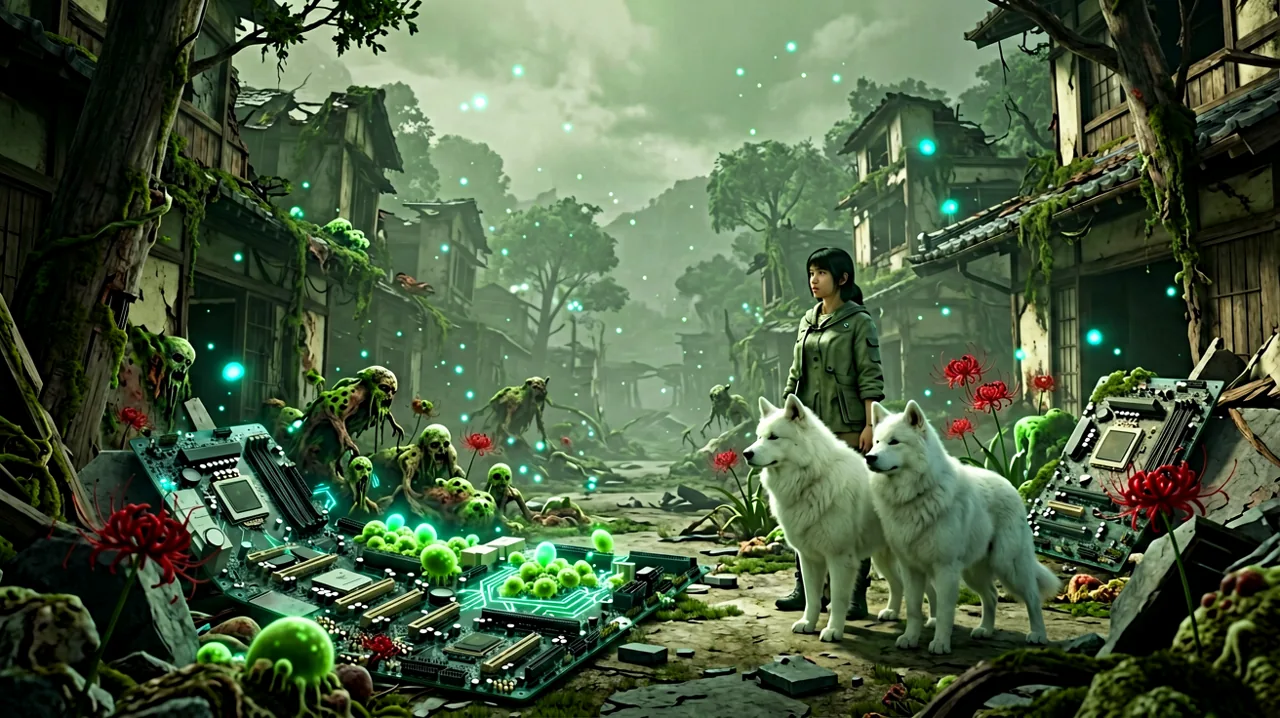
It has been a little over a month since Game Freak launched Beast of Reincarnation, taking a massive, highly publicized leap from their traditional monster-catching roots into the grim, parasite-infested future of 4026 Japan. As players continue to meticulously map out the ruined landscapes and master the game’s unforgiving parry systems, community discussions across social media and forums have steadily evolved. Today, we are looking at two major topics currently dominating the community conversation: the much-requested availability of the game’s full Original Soundtrack (OST) and an ongoing, fiercely debated technical hurdle regarding PC performance—specifically, how different processor architectures handle the title’s notorious 1% low frame drops during open-world traversal.
The Sound of 4026: Full Soundtrack Circulation
Since release, one of the most universally praised aspects of Emma and Koo’s harrowing journey has been the suffocating, melancholic atmosphere. Recently, dedicated community members on the game’s primary subreddit compiled and shared the complete Beast of Reincarnation Original Soundtrack. For players who want to experience the haunting melodies outside of the game client, this full collection serves as a stark reminder of how effectively the audio design builds the world-building of 4026 AD.
The soundtrack is a masterful fusion of traditional Japanese instrumentation—such as the sharp twang of the shamisen and the breathy, hollow notes of the shakuhachi flute—corrupted by heavy, industrial synths that represent the creeping influence of the blight. When you are resting at one of the isolated mountain settlements, the music is sparse and gentle, giving you a brief, desperately needed respite from the horrors of the overworld. The acoustic arrangements in these safe zones highlight the fragile humanity of the survivors holding out against the parasitic threat.
However, the moment you step out into the overgrown ruins of a collapsed civilization, the audio landscape shifts into something far more hostile. Listening to the OST in isolation highlights the intricate layering used for the different malefact encounters. The erratic time signatures and aggressive percussion during the Nushi Taurus boss fight perfectly mirror the creature’s unpredictable, mutated movements. Meanwhile, the ambient tracks associated with Emma’s Sealer abilities carry an ethereal, almost tragic choir arrangement, underscoring the severe physical toll that manipulating her plant-like hair takes on her human body. The emotional resonance of the narrative—and the excellent performances discussed in our voice cast breakdown—is elevated immensely by this underlying score.
Audio Cues and Hardcore Combat Survival
Beyond pure atmospheric immersion, the audio design in Beast of Reincarnation functions as an essential survival tool. If you have spent any significant amount of time studying our combat guide, you understand that the game’s difficulty is intensely unforgiving. Visual telegraphs for enemy attacks are frequently obscured by the chaotic, swirling visual effects of the blight spores and environmental destruction. In many high-stakes situations, you must rely entirely on subtle audio cues to maintain your defensive rhythm.
The sharp clash of steel against mutated flesh, the specific, high-pitched shrieks that precede an unblockable grab attack, and the low, guttural rumble indicating an impending area-of-effect explosion are all mixed brilliantly to stand out above the orchestral swells. More importantly, these audio cues are absolutely vital when coordinating attacks with your canine companion. Because Koo operates largely autonomously during frantic skirmishes until directly commanded, listening for his distinct barks allows you to know exactly when his tactical assist abilities are ready to be triggered, as outlined in our detailed analysis of Koo’s tactical mechanics.
A missed audio cue often results in a missed opportunity to stagger a massive malefact, which usually leads directly to a swift and punishing death. Furthermore, the sound of successfully absorbing blight from a fallen enemy—a critical mechanic for restoring health and charging your spirit stones—provides a deeply satisfying auditory feedback loop that rewards aggressive, well-timed play. The pristine clarity of these sound effects amidst the booming, chaotic combat score is a testament to the development team’s distinct audio mixing priorities.
A Symphony Interrupted: The Traversal Stutter Issue
Unfortunately, the game’s stellar audio and visual presentation are still being severely hampered by lingering technical struggles on the PC platform. Despite Game Freak releasing several updates aimed at addressing camera issues and implementing better upscaling solutions, a significant portion of the PC player base continues to battle severe traversal stuttering. A recent, highly active thread on the ArgenGaming subreddit perfectly encapsulates the current frustration felt by the community.
A user running a remarkably modern, high-end PC rig—equipped with a Ryzen 5 9600 CPU, 6000 MHz DDR5 RAM, a high-speed NVMe SSD, and an Nvidia RTX 5070 Ti—reported miserable 1% low framerates and constant micro-stutters. Playing at a 1440p resolution with maximum graphical settings and Ray Tracing enabled, they noted that every time they moved between major zones or navigated the dense environments using Emma’s vine traversal, the game would hitch hard enough to actively ruin the immersion.
This is certainly not an isolated incident. Beast of Reincarnation, being a visually ambitious title built on Unreal Engine 5, pushes incredibly dense environment geometry and calculates complex particle physics related to the ubiquitous blight corruption. When a player moves rapidly through the overworld, the engine often struggles to stream these massive high-fidelity assets smoothly. This pipeline issue causes the CPU to temporarily choke while the GPU sits idle waiting for instructions. The end result is a series of jarring stutters that disrupt the framerate and, occasionally, cause the pristine audio tracks to briefly desync and crackle. For a hardcore action game that demands precision timing, experiencing a sudden frame drop during a split-second parry window is incredibly frustrating.
The X3D Processor Debate
The core of the current community discourse revolves around a brute-force hardware solution to what is ultimately a software optimization problem. In the aforementioned performance threads, tech-savvy players observed that users equipped with AMD’s X3D processors (such as the 7800X3D or the newer 9000X3D variants) report a noticeably smoother gameplay experience and far fewer traversal hitches. The frametime metrics are reportedly much more stable on these specific chips, creating a massive disparity in player experiences.
The underlying theory discussed by the community is relatively straightforward: Unreal Engine 5’s aggressive asset streaming and the dense mathematical calculations required for Game Freak’s world simulation are intensely CPU-heavy tasks. Standard processors with typical cache sizes, even incredibly fast and modern ones like the Ryzen 5 9600, eventually hit a memory bandwidth bottleneck when constantly dumping and loading new high-resolution environment data. The massive L3 cache (3D V-Cache) present on X3D chips allows the CPU to keep vastly more game data readily available on the die itself, effectively brute-forcing its way through the engine’s unoptimized streaming hitches.
It is community-reported that these larger cache sizes prevent the engine from stalling out when loading in a new highly detailed zone or when a massive malefact boss suddenly spawns a dense cloud of blight spores. While this is fascinating from a hardware enthusiast perspective, it offers little comfort to the average player who simply wants their expensive gaming rig to run the title without constant hiccups.
Settings, Workarounds, and Future Expectations
For players unwilling or unable to upgrade their entire motherboard and CPU architecture just to play one specific game smoothly, the community consensus is to lean heavily on our established PC settings and optimization tips. Turning off Ray Tracing entirely remains the most effective, immediate way to alleviate CPU overhead. While Ray Tracing undoubtedly adds incredible depth and realism to the lighting of the ruined, overgrown Japanese architecture, the performance cost is simply too high for standard CPUs during rapid movement and chaotic combat scenarios. It is highly recommended to cap your framerate slightly below your average maximum to smooth out the frametime graph and reduce the severity of the 1% lows.
It is currently not yet confirmed whether Game Freak plans to release a dedicated, engine-level optimization patch aimed specifically at improving CPU threading and asset streaming. An official roadmap regarding deep technical fixes is still expected by the community, though no timeline has been provided.
As we move further into the post-launch window, the dichotomy of Beast of Reincarnation remains a fascinating topic. On one hand, the wider availability of the OST allows us to celebrate an undeniable, breathtaking artistic achievement. On the other, the ongoing stuttering debates highlight the friction and frustration of playing ambitious, bleeding-edge Unreal Engine 5 titles on the PC platform. Until a definitive software fix is released, players will have to meticulously balance their visual fidelity settings against the framerate stability required to survive the blighted wilderness.